The numbers
Organic is a small part of Japanese farming. MAFF's September 2025 overview of organic agriculture puts organic JAS land at about 0.8 percent of cultivated area in 2023. Tea is the exception. The same ministry's Kyushu office, in a March 2025 study-group paper on organic tea, cites an organic area ratio for tea of about 4.6 percent and notes that tea makes up roughly 8 percent of all organic JAS farmland in Japan. In production terms, MAFF reports that about 6.6 percent of green tea (aracha) was graded organic JAS in fiscal 2023, and organic tea was the largest single item among Japan's organic exports under the equivalence arrangements that year, at about 1,585 tons.
Inside that organic tea sector, one prefecture dominates. The Minami-Nippon Shimbun has reported Kagoshima's organic JAS tea area at 889 hectares, about half of the national total. The MAFF Kyushu paper gives a slightly earlier figure of 751 hectares, which it puts at about 9 percent of the prefecture's 8,183 hectares of tea. Kagoshima's own export plan for organic matcha, published in 2018, had the organic area at 532 hectares in 2017, up from 221 in 2011. Whichever year you take, the direction is the same: the organic tea area in Kagoshima has roughly quadrupled in a little over a decade.
| Figure | Value | Source |
|---|---|---|
| Organic JAS share of all cultivated land, Japan, 2023 | about 0.8% | MAFF, Situation Surrounding Organic Agriculture, Sept 2025 |
| Organic area ratio for tea | about 4.6% | MAFF Kyushu, organic tea study group, March 2025 |
| Green tea graded organic JAS, FY2023 | about 6.6% of production | MAFF, Sept 2025 |
| Organic tea exports under equivalence, 2023 | about 1,585 t | MAFF, Sept 2025 |
| Kagoshima organic JAS tea area | 889 ha, about half of Japan | Minami-Nippon Shimbun, reported |
| Kagoshima organic tea area, 2011 to 2017 | 221 ha to 532 ha | Kagoshima Prefecture organic matcha export plan, 2018 |
| Kagoshima tencha output, 2022 | 1,392 t, first in Japan | MAFF, Kagoshima tea profile |
Why the south: climate and cultivars
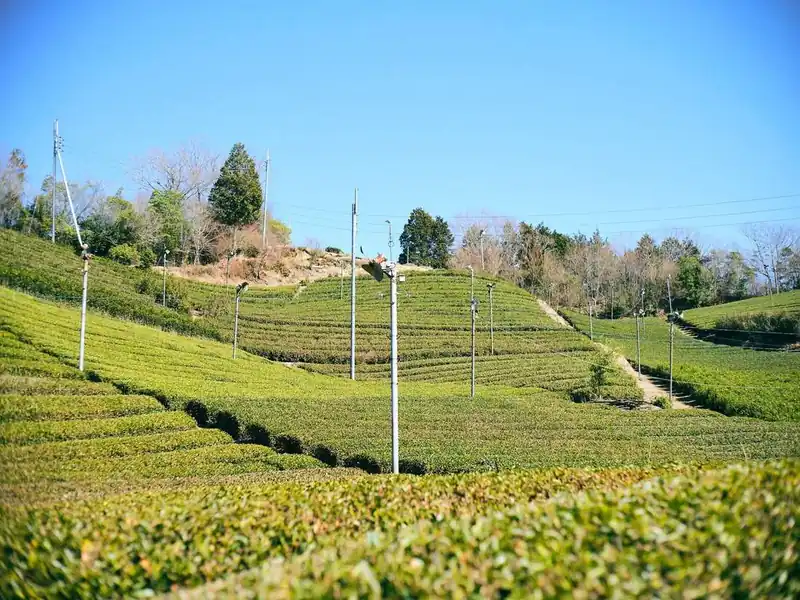
Kagoshima sits at the southern tip of Kyushu. It is warm, wet and early: MAFF's profile of Kagoshima tea notes that the first picking, called hashiri shincha, starts in late March, and that the harvest season is unusually long. Much of the tea grows on flat volcanic plateaus rather than hillside terraces, which is why the prefecture could bring in large harvesting machinery and run bigger fields. Flat fields matter for organic growing because weeding without herbicide is the main cost, and a machine can do it between straight rows.
The second reason is the plant itself. Japan's tea area is dominated by the Yabukita cultivar, but the MAFF Kyushu paper points out that Kagoshima has the lowest Yabukita share of any major producer, around 32 percent, because its warm, rainy climate pushed growers towards disease-resistant cultivars decades ago. Yabukita is susceptible to pests and disease and, the paper adds, gives lower quality under shade, so it is a poor fit for both organic growing and tencha. Its mix of Yutakamidori, Asatsuyu, Saemidori and Okumidori across the season is what an organic matcha grower would choose from scratch; our region comparison covers what that does in the cup.
The two pests that decide an organic field
The MAFF Kyushu paper names the obstacles plainly: the tea green leafhopper, and two leaf diseases, anthracnose and red leaf blight. An outbreak in June can take out the income of a whole second harvest. A conventional field answers it with a spray; an organic field answers it with cultivar choice, pruning cycles that remove infected shoots, and increasingly with machinery, and the same paper reports trials of inter-row weeders that cut weeding time substantially. None of this is cheap, which is why organic tea stays concentrated where climate and cultivars give the grower a head start.
From organic sencha to organic matcha
For most of its history Kagoshima's organic tea was sencha, sold to health-food and export channels. The shift to tencha, the shaded leaf that becomes matcha, is recent and deliberate. In 2018 the prefecture published a basic plan for promoting organic matcha exports, with a 2025 target of 400 tons and 1.6 billion yen, and by 2022 MAFF listed Kagoshima as Japan's largest tencha producer at 1,392 tons. The Global Japanese Tea Association's May 2026 report, citing the Mainichi Shimbun, puts the prefecture's tencha output at about 2,150 tons in 2024, roughly 40 percent of the national total. Uji still sets the price and the reputation; Kagoshima sets the volume, and a large share of the organic volume.
What organic means on our lots
On a Japanese organic lot, the certificate belongs to the field and to the mill, not to the exporter. The field is inspected and certified under JAS by a registered certification body, the mill that shades, steams, dries and grinds the leaf holds its own JAS certification for handling, and the lot number ties the two together. We buy at the mills and ship their certificates with the goods; we do not hold the certification ourselves. Our guide to JAS and USDA organic goes through what each mark covers and how a JAS lot is labelled organic in the United States under the equivalence arrangement.
The organic lot in our catalog today is Jun: first-harvest Yutakamidori from Kagoshima, certified JAS and USDA, at $275 / kg, FOB Osaka, with a 1 kg minimum. Its conventional twin, Yutaka, is the same cultivar and harvest grown without the certification, at $225 / kg. More certified organic lots are being added to the organic section of the catalog this season.
In the cup, and on the invoice
Yutakamidori is a sweet, light, very green cultivar, and a first-harvest organic lot of it drinks softer than a Yabukita of the same grade: less edge, a rounder finish, a colour that holds in milk. In our own tastings, organic first harvests show a little less of the heavy umami that nitrogen-fed shaded tea is known for, because organic fertiliser releases slowly. For a latte that is rarely a loss; for usucha it is a style, not a defect.
On the invoice, the organic premium on our list is the difference between Jun and Yutaka: $50 per kilo, which at 4 g per latte is 20 cents of tea per cup. That is the whole cost of putting the word organic on a menu.
Buying organic for the EU, the UK and the US
- EU and UK. We ship only certified organic lots there, because the organic Certificate of Inspection and the importer's own registration are the paperwork that makes a first shipment painless. Our guide to the COI and TRACES walks through it, and the Germany and UK pages give freight and duty.
- United States. A JAS lot can be sold as USDA organic under the equivalence arrangement, with the import certificate issued for the shipment. FDA prior notice is filed by us before the parcel leaves Osaka.
- Everywhere else. The JAS certificate travels with the lot; whether your market recognises it is a question for the local organic regulator.
If organic is the brief, start with a 20 g sample of Jun and of Yutaka side by side. The cultivar and the harvest are the same; what you are tasting is the field. Most buyers are surprised by how small the difference is.
Questions buyers ask
Where is most of Japan's organic tea grown?
In Kagoshima, at the southern tip of Kyushu. The Minami-Nippon Shimbun has reported the prefecture's organic JAS tea area at 889 hectares, about half of Japan's total, and MAFF's Kyushu office ranks it first for organic tea area and for tencha output.
Why is Kagoshima suited to organic tea?
A warm, early climate, a cultivar mix with the lowest share of pest-prone Yabukita among the major regions, and flat fields that can be weeded and harvested by machine. The main obstacles are the tea leafhopper and two leaf diseases, which organic growers manage with cultivar choice, pruning and mechanical weeding.
Is organic matcha from Kagoshima certified for the EU and the US?
Our organic lots are certified JAS at field and mill. Under the equivalence arrangements a JAS lot can be imported as organic into the EU with a Certificate of Inspection and labelled USDA organic in the United States. The certificates are held by the mill and ship with the lot.
How much more does organic matcha cost?
On our list the organic first-harvest Yutakamidori, Jun, is $275 / kg, FOB Osaka, and the conventional lot of the same cultivar and harvest, Yutaka, is $225 / kg. At 4 g per latte the difference is 20 cents of tea per cup.
Prices and lots named in this article are as published on Nov 2026; the catalog always carries the current list price per kilo.