Why we test instead of trusting the label
There is no legal definition of ceremonial matcha in Japan or anywhere else. A mill can call a lot ceremonial because it is first harvest, because it is stone milled, because it is the best lot they have that year, or because the buyer asked for the word on the bag. We have been sent ceremonial lots that were fine for a latte and nothing else, and café lots that whisked into a usucha we were happy to drink. So the label is where we start, not where we stop.
Every lot we consider goes through the same four tests. They take about half a day, cost a few grams of tea, and they are what decides the grade you see on the product page and the price next to it. Our grades page has the definitions; this is how we apply them.
Test 1: the paper
Before the bag is opened we read the spec sheet and the certificate of analysis that come with it. We are looking for four lines: the harvest (first, second or autumn), the cultivar or the word blend, the milling date, and the particle size. A first-harvest lot that was milled eight months ago is not what the word ceremonial promises, and a lot with no milling date goes no further. The COA tells us about moisture, microbiology and residues, which are the mill's responsibility and which we do not test on our own bench. Our guide to reading a COA goes through every line.
The paper test also sets expectations. If the sheet says second harvest and the price asks for first-harvest money, the cup has a lot to prove.
Test 2: the dry powder
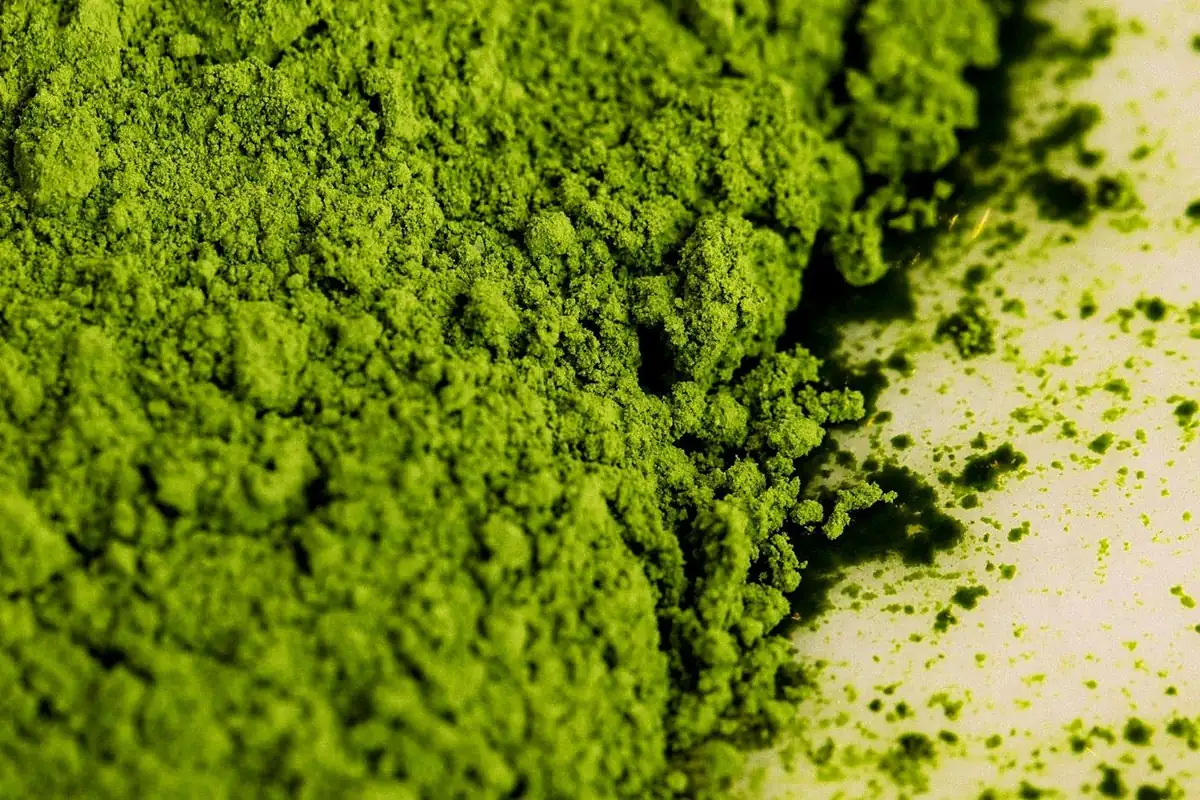
We tip a spoonful onto white paper next to a reference lot of the same grade from last season, in daylight, and look at the colour. Ceremonial should be a vivid, slightly blue green; café a clear green; culinary a green with yellow in it. Then we rub a pinch between finger and thumb. A fine mill feels like talc and leaves a smear with no grit; a coarse one feels like flour. Fineness matters because it is what makes foam in a usucha and what keeps the powder suspended in a latte instead of settling, which is why we quote the particle size from the spec sheet rather than the word on the bag. Our note on mills explains why the mill type alone tells you less than you think.
Test 3: straight, as usucha
Two grams sifted into 70 ml of water at 75 °C, whisked for fifteen seconds. This is the test a ceremonial lot has to pass and a café lot does not. We look at the foam first: fine and even, holding for a minute, means fine milling and fresh powder. Then the nose, which should be grassy and sweet, never hay or cardboard. Then the taste in three parts: the sweetness and umami at the front, the bitterness in the middle, and whether it is clean or drying at the end. A lot that is sweet, umami-led and finishes clean with the bitterness in proportion is a ceremonial candidate. A lot that is pleasant but thin, or that leans on bitterness, is a café candidate even if the bag says otherwise.
Kiwami, the most expensive matcha we sell at $510 / kg, FOB Osaka, is a single-field first harvest from Shizuoka that we grade on this test alone: it has the umami and the clean finish to be made as koicha, thick tea at four times the dose, which only a handful of lots can stand. The koicha guide lists which of our lots pass that bar.
Test 4: in milk, until 3 pm
Four grams in 40 ml of water at 80 °C, then 180 ml of milk, made twice: one hot, one over ice. The hot one we taste straight away. Does the matcha come through the milk, or does it disappear into sweet dairy? A café grade needs more body and a touch more bitterness than a ceremonial lot precisely so that it survives this. The iced one we photograph, then leave on the bench and photograph again at one, three and five hours. The lot that is still green at 3 pm is the one a café can serve all day. The lot that has gone olive by lunch is a culinary candidate, however it tasted in the bowl. The chemistry behind that is in our piece on why iced lattes turn brown.
| Test | What we look for | Ceremonial | Café | Culinary |
|---|---|---|---|---|
| 1. Paper | Harvest, cultivar, milling date, particle size | First harvest, milled this season | First or second harvest, or a blend | Second or autumn harvest |
| 2. Dry | Colour against a reference, fineness between fingers | Vivid blue green, talc fine | Clear green, fine | Yellow green |
| 3. Usucha | Foam, aroma, umami, bitterness, finish | Must pass: sweet, umami, clean | Pleasant, may lean bitter | Not tested |
| 4. Milk, 5 hours | Flavour through milk, colour at 1, 3 and 5 hours | Delicate; may vanish in milk | Must pass: body and colour at 3 pm | Flavour survives sugar and heat |
What the results decide
The pattern is simple once you have run it a few times. Ceremonial is the grade that passes test 3; nothing that fails as usucha gets the name, whatever the mill calls it. Café is the grade that passes test 4; the best café lots also make a decent usucha, but that is a bonus, not the brief. Culinary is the grade with enough flavour to survive sugar, fat and an oven, which is a different virtue again, and one that a delicate first-harvest lot usually lacks.
The tests are also why some lots move between grades from one season to the next. A second-harvest lot from a cool year can pass test 3; a first-harvest lot milled too long ago fails test 2 before it reaches the whisk. The grade on the product page is the grade of the lot in stock, not of the field.
Why the price gap is what it is
The gap between $510 / kg for Kiwami, $275 / kg for a café standard such as Wa and $180 / kg for a culinary lot such as Mine is not a markup on a word. It is the harvest, the shading and the yield. A first-harvest tencha field shaded for three weeks gives one small crop of leaf that has to be picked, sorted and milled slowly; a second-harvest or autumn crop gives more leaf from the same bushes with less work and less sweetness. The tests measure exactly what that extra cost bought, which is why a lot that fails test 3 cannot carry a first-harvest price with us, and why a lot that passes test 4 at a second-harvest price is the best buy on the catalog for most cafés.
Questions buyers ask
What is the difference between ceremonial and café grade matcha?
For us, ceremonial is a lot that passes a straight usucha test: sweet, umami-led, clean finish, fine foam. Café grade is a lot that passes the milk test: enough body to taste through 180 ml of milk and enough colour to still be green after five hours over ice.
Is ceremonial grade a regulated term?
No. There is no legal definition in Japan or in importing countries. Any seller can print it. That is why we grade every lot by the same four tests rather than by the word on the bag.
Can a café grade matcha be drunk straight?
Often, yes. The best café lots make a pleasant usucha, but they are chosen for how they perform in milk, so expect more body and a little more bitterness than a ceremonial lot.
Why is ceremonial matcha so much more expensive?
It is first-harvest, shaded leaf picked once a year and milled slowly, so the yield per bush is small and the labour high. Second-harvest and autumn crops give more leaf for less work, which is what the price per kilo reflects.
Prices and lots named in this article are as published on Nov 2026; the catalog always carries the current list price per kilo.