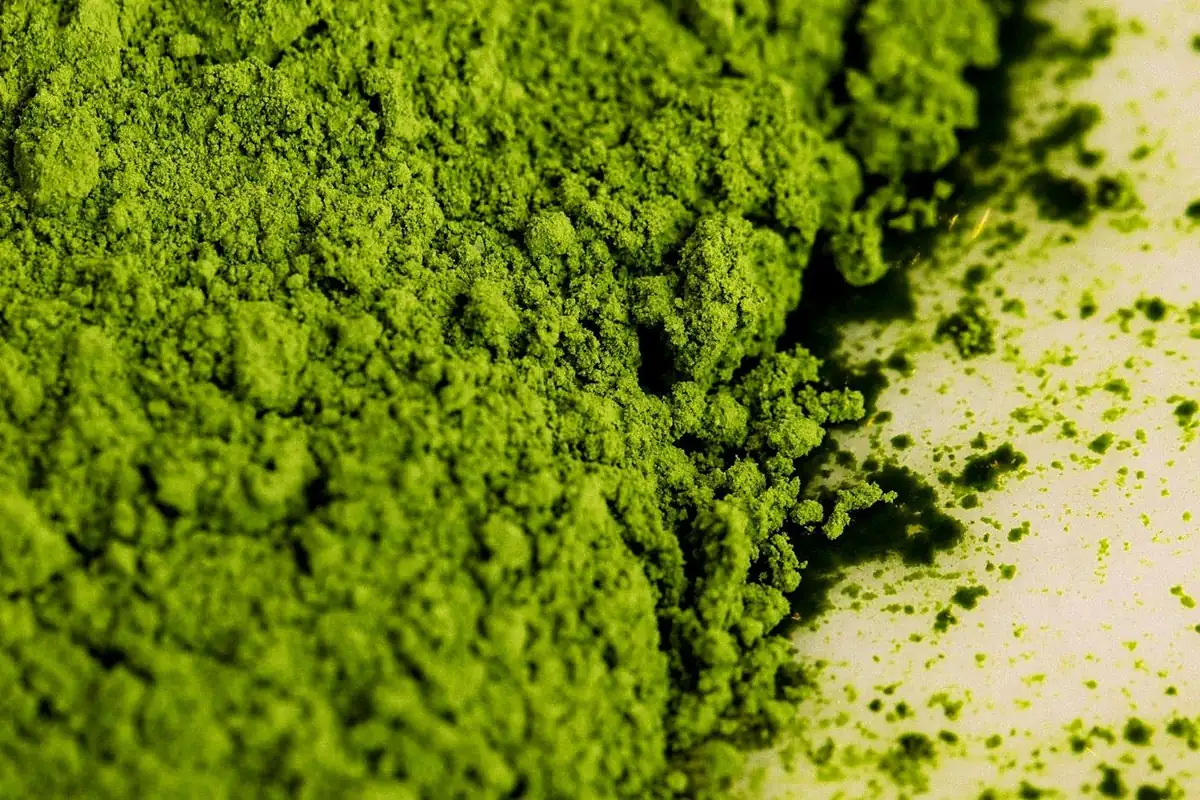
What the kitchen asks of matcha
In a latte, matcha has an easy life: hot water, milk, a few minutes, done. In a kitchen it is mixed with sugar, cooked into a custard, churned with air, frozen, or baked at 180 °C with butter and eggs. Every one of those steps attacks the two things you are paying for, the green colour and the umami. Heat and oxygen bleach chlorophyll, sugar and fat dilute flavour, and acid turns the colour olive. The chemistry is the same one that browns an iced latte, just faster and with more variables.
So the question is not which matcha tastes best from the bowl. It is which one still looks and tastes like matcha after your process, at a dose your margin can carry.
Which grade for which product
For almost everything in the kitchen the answer is a culinary or café grade with strong flavour, not a first-harvest ceremonial lot. Delicate sweetness and a fine foam are wasted under sugar and cream; what survives is body, a slightly stronger bitterness that reads as tea, and a deep colour that can afford to lose a little. That is why Mine, our most cost-competitive matcha at $180 / kg, FOB Osaka, is the lot we send most kitchens first: a blended Shizuoka lot built to hold its flavour in volume, from a mill that also holds halal and kosher certification. For the lowest cost per portion, Aki and Minori are autumn-harvest tencha milled for food production at $100 / kg, FOB Osaka.
Where a ceremonial lot does earn its place is a product that is barely processed: a no-bake matcha cream, a white chocolate ganache, a soft serve served within hours, or a signature dessert where the matcha is the headline and the price is on the menu. For those, a second-harvest café grade such as Megumi at $185 / kg gives more body than a ceremonial lot at a fraction of the price. The grades page sets out how we draw those lines.
| Product | Grade we suggest | Why |
|---|---|---|
| Ice cream and gelato base | Culinary (Mine, Aki) | Cold protects colour; strong flavour carries through cream and sugar |
| Soft serve mix | Culinary (Mine) | Dosed by the litre of mix; needs flavour at low cost |
| Cookies, financiers, pound cake | Culinary (Aki, Minori) | Oven heat costs colour anyway; bitterness reads as tea against butter |
| Pastry cream, mousse, cheesecake | Café (Megumi, Nami) | Little or no heat after mixing; colour and umami show |
| Ganache, no-bake, plated dessert | Café or ceremonial | The matcha is the headline; dose low and let it taste sweet |
Starting doses by product
These are the doses we start from when a customer sends us their recipe, written as a share of the base or the flour so they scale. Every kitchen adjusts them up or down after one batch, usually by a quarter either way. Culinary grades need the higher end of each range; café grades the lower end.
- Ice cream and gelato base: 1.0 to 1.5% of the base by weight, so 10 to 15 g per kilo of base. Below 1% the colour reads mint rather than matcha once churned with air.
- Soft serve: 0.8 to 1.2% of the liquid mix, 8 to 12 g per litre. Soft serve is served fresh and never deep-frozen, so it can run a little lighter than hard ice cream.
- Cookies and financiers: 3 to 4% of the flour weight, 8 to 10 g per 250 g of flour. Oven heat takes some of the green, so start high.
- Pound cake and loaf cake: 3 to 5% of the flour, blended into the sugar first.
- Pastry cream, mousse, cheesecake: 1 to 2% of the finished weight, whisked into a small amount of the warm liquid first.
- White chocolate ganache: 2 to 3% of the chocolate weight, sifted straight into the melted chocolate before the cream.
One warning on the top end: matcha past about 5% of flour weight turns a cake dense and bitter without making it greener. If you want more colour, change the grade, not the dose.
Technique: the four things that protect the green
- Blend with the sugar first. Sift the matcha into the sugar and whisk them together dry. Sugar crystals separate the particles, so the powder disperses without lumps when the liquid arrives. It also coats the particles and slows oxidation during mixing.
- Keep it off direct heat. For a custard or ice cream base, cook the dairy and eggs, then whisk the matcha into the warm base off the stove, or into a cup of the base before adding it back. Boiling matcha strips aroma and dulls the colour in minutes.
- Keep acid away from it. Lemon, yogurt, cream cheese and fruit purees push the colour towards olive. If the recipe needs acid, add it last, cold, and expect to use the higher end of the dose.
- Cold and dark, always. Chill the base fast, churn it cold, and keep finished product covered. A tub of matcha gelato left under display lights all afternoon loses colour at the surface, the same way an iced latte does. Scrape the top before service if it has sat.
- Store the powder like a café does. Opened bags in the fridge, finished within six weeks. Our storage guide covers it.
Cost per portion
Kitchen matcha is cheap per portion even at café-grade prices, because the dose per serving is small and the product sells at a dessert price. At $180 / kg, one gram of Mine costs $0.18. A 100 g scoop of ice cream at 1.2% carries 1.2 g of matcha, about $0.22 of tea. At $100 / kg for Aki, the same scoop is about $0.12. A financier at 9 g of matcha per 250 g of flour, which makes roughly twelve pieces, carries under $0.14 of tea each at $180 / kg, and under $0.08 at $100 / kg.
Those numbers are why we steer kitchens away from first-harvest lots for anything baked or churned. The extra $100 to $300 per kilo buys foam and delicacy that the process destroys. Spend the difference on dose, which the customer sees as colour.
Ordering in bulk
One matcha flavour uses roughly a kilo of matcha per 70 to 100 litres of base, so most kitchens order 1 to 5 kg at a time and reorder monthly. Mine ships from 10 kg, as it comes from the halal and kosher certified line; Aki, Minori, Megumi and Nami ship from 1 kg, as 100 g foil bags or 1 kg bulk. Prices are per kilo FOB Osaka, quoted with freight and duties within one business day, and a standing order holds the price for the harvest year. The culinary and café lots are in the catalog, filtered by use.
Questions buyers ask
What grade of matcha should I use for ice cream?
A culinary grade with strong flavour. Cold protects the colour, and cream and sugar dilute flavour, so a lot like Mine at $180 / kg or Aki at $100 / kg carries through better than a ceremonial lot at a fraction of the cost.
How much matcha do I put in ice cream base?
Start at 1.0 to 1.5% of the base by weight, which is 10 to 15 g per kilo. Below 1% the colour reads mint once the base is churned. Adjust by about a quarter after the first batch.
How much matcha for baking cookies or cakes?
3 to 4% of the flour weight for cookies and financiers, 3 to 5% for pound cake, blended into the sugar first. Above 5% the crumb turns dense and bitter without getting greener.
Why did my matcha cake turn brown?
Oven heat and oxygen bleach chlorophyll, and acid speeds it up. Use a stronger culinary grade at a higher dose, keep acidic ingredients to a minimum, and avoid overbaking. Some colour loss in the oven is normal.
Prices and lots named in this article are as published on Nov 2026; the catalog always carries the current list price per kilo.