The three mills
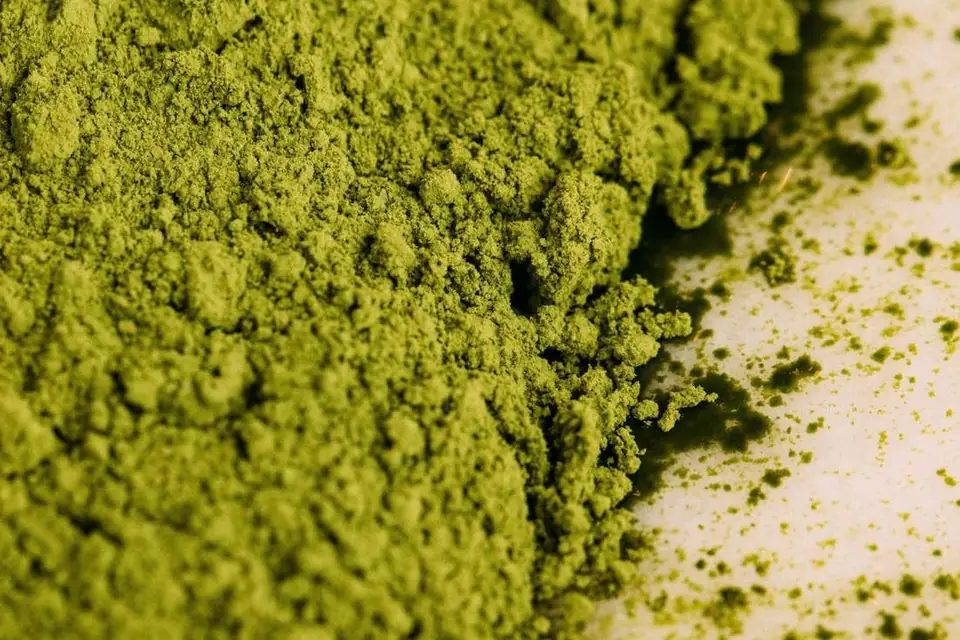
Tencha arrives at the mill as dry, brittle leaf flakes with the stems and veins removed. Turning it into matcha means grinding it to a powder a few microns across. There are three ways to do that, and each one leaves a fingerprint.
- Stone mill (ishiusu). Two granite stones, the top one turning at about 30 rpm, grind the leaf between hand-cut grooves. One mill makes roughly 40 g an hour. The particles are irregular, very fine, and cool, because the stones are heavy and slow. This is the traditional method and the slowest by a factor of a hundred.
- Ball mill. A rotating drum with ceramic balls tumbles the leaf for hours. Output is far higher, particle size can be brought close to stone-milled, and the shape is more rounded. Most café-grade matcha in the world comes off ball mills.
- Jet mill (air-flow mill). Compressed air throws the particles against each other at high speed. It is the fastest and gives the tightest, most uniform particle size, with more airflow and therefore more exposure of the powder to air during milling.
Particle size, foam and suspension
Matcha is a suspension, not a solution. The powder does not dissolve; it hangs in the water. Smaller particles hang longer, feel smoother on the tongue and hold foam better because the foam's bubble walls are stabilised by fine particles and the leaf's natural saponins. Good matcha is milled to a median particle size (D50) of roughly 5 to 10 µm. Above about 15 µm it feels gritty, settles in the bottom of a latte within minutes and looks muddy in a clear cup.
| Stone mill | Ball mill | Jet mill | |
|---|---|---|---|
| Typical D50 | 5 – 8 µm | 6 – 12 µm | 4 – 8 µm |
| Particle shape | Irregular, flaky | Rounded | Uniform, fine |
| Heat during milling | Lowest | Low – moderate | Low, but high air contact |
| Output per hour | ~40 g per mill | Kilograms | Kilograms |
| Foam (usucha) | Finest, most stable | Good | Good, sometimes thinner |
| Cost added per kg | Highest | Low | Low |
Heat and aroma
The reason stone milling is prized is not the stone, it is the slowness. Grinding creates heat, and heat drives off the volatile aroma compounds and dulls the chlorophyll. A stone mill turning at 30 rpm barely warms the leaf. A badly run ball mill can cook it. A jet mill keeps it cool but moves a lot of air through the powder, and some tasters find jet-milled matcha slightly flatter in aroma for that reason. In a latte, with 200 ml of milk over the top, almost nobody can tell the three apart. Whisked straight, in a bowl, with a first-harvest leaf, a good stone-milled lot is noticeably rounder and its foam lasts longer.
Stone milling is worth paying for on the lots you drink straight. It is wasted on the lots you drink through milk.
When stone milling is worth it
Our rule: stone mill the ceremonial lots (Yame, Hoshi, Kiwami) and any lot destined for usucha, and fine ball-mill the café and culinary lots where the milk or the butter does the finishing. The spec sheet says which; so does every product page on this site. One more thing worth knowing: a mill can only do so much. The particle size and the foam come from the mill, but the colour, the sweetness and the bitterness were decided in the field by shading and harvest. A stone-milled second harvest is still a second harvest. Our note on harvests covers that half.
Questions buyers ask
Is stone-milled matcha better?
For usucha and anything drunk straight, usually yes: the slow, cool grind keeps more aroma and gives a finer, more stable foam. In a latte the difference is hard to taste, and a fine ball-milled café grade is the better buy.
What particle size should matcha be?
A median (D50) of roughly 5–10 µm. Above about 15 µm the powder feels gritty and settles quickly in a drink.
Why does my matcha not foam?
Usually particle size (too coarse), too little powder for the water, water that is too hot or too cold, or leaf that was not shaded. Try 2 g in 70 ml at 75 °C with a bamboo whisk or a milk frother; if it still will not foam, ask the supplier for the D50.